
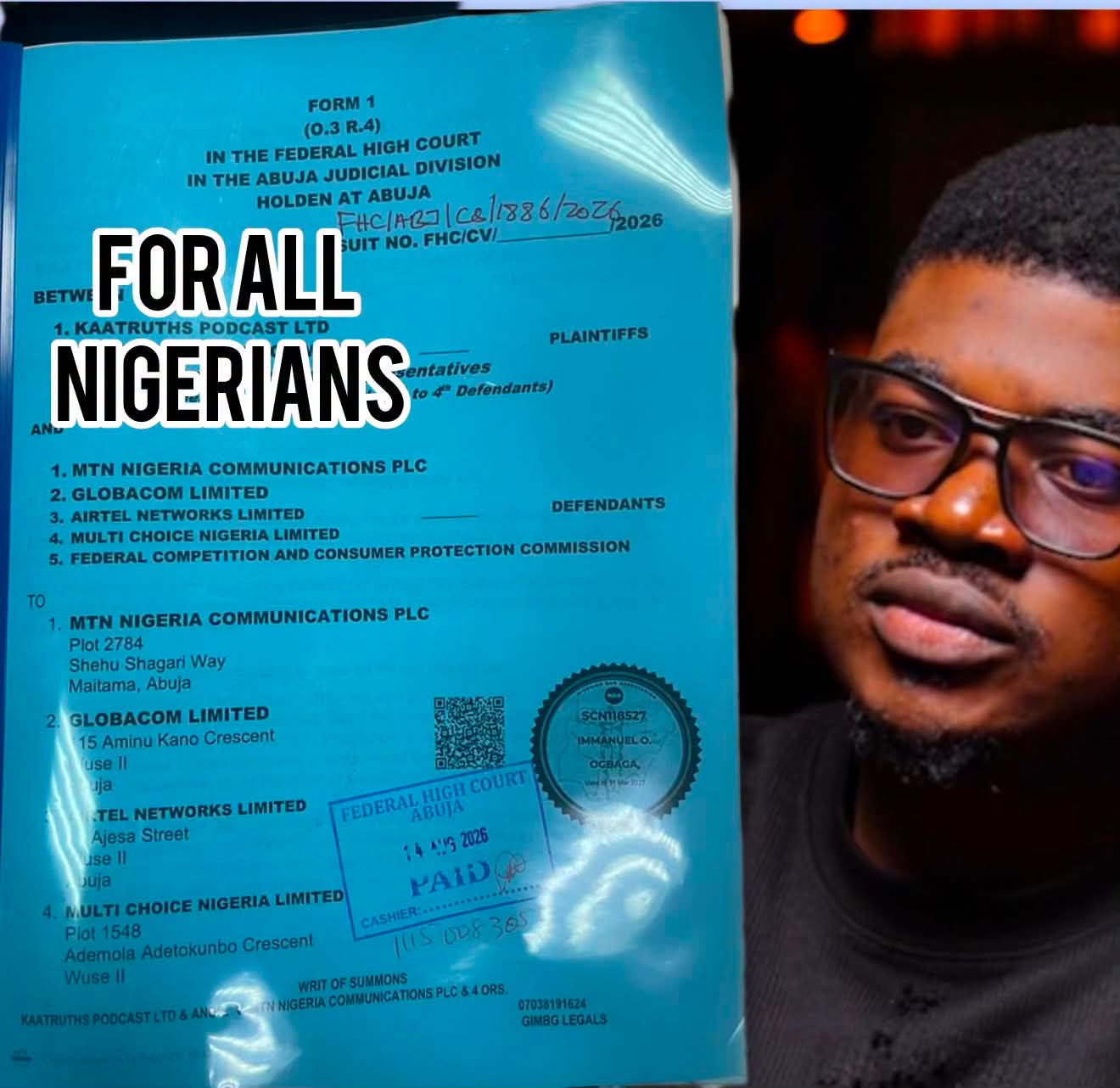
Kel Armstrong Amobi, popularly known as KAA, founder and host of KaaTruths Podcast, and KaaTruths Podcast Ltd have dragged MTN Nigeria, Globacom, Airtel Networks and MultiChoice Nigeria before the Federal High Court in Abuja, demanding N50 billion in general and special damages over alleged violations of consumers’ rights.
The suit also names the Federal Competition and Consumer Protection Commission (FCCPC) as a defendant.
Amobi, a blogger and social media commentator, disclosed the legal action in a Facebook post on Friday, saying the case was filed to challenge unfair practices involving data bundles and subscription services.
At the centre of the case is the expiration of unused data. Amobi questioned why consumers can lose data they have already paid for simply because a specified validity period has elapsed.
“If I buy a 30-day data bundle and consume all of it in five days, the telecommunications company tells me my data has been exhausted and I must buy another bundle,” he said.
“Fair enough. But if after 30 days I have not consumed everything I paid for, the remaining data can expire.”
He argued that the arrangement creates a contradiction in how consumers’ usage is treated.
“So when consumption favours the service provider, usage determines what I have left. But when expiration favours the service provider, time suddenly determines what I have left,” he said.
“How can both principles apply against the consumer?”
The plaintiffs are also challenging situations where consumers are unable to use their data because of network problems or other service-related disruptions, but still lose the unused portion when the bundle expires.
Amobi cited an incident involving a N30,000 MTN data subscription purchased for 30 days. According to him, the router supplied for accessing the service developed a fault, and although cancellation, a refund or rollover of the unused subscription was requested, the request was refused and the subscription eventually expired.
Another incident cited in the suit involved 75GB of data which, according to Amobi, was exhausted in less than seven days despite intermittent network disruption.
He said no satisfactory breakdown was provided showing how the 75GB was consumed.
The plaintiffs are asking the Federal High Court to determine whether terms allowing unused data bundles to expire simply because a stipulated period has elapsed are unfair, unreasonable and contrary to consumers’ rights.
They are also challenging what they described as the absence of meaningful cancellation options in subscription arrangements.
The case extends to MultiChoice Nigeria’s subscription model, with the plaintiffs asking the court to examine situations where television subscriptions continue to run during periods when the service is not being used or is disrupted.
Among the reliefs being sought is an order restraining the companies from continuing any practices the court finds to be unfair and unlawful.
The plaintiffs are also seeking N50 billion in general and special damages over the alleged violations of consumer rights.
Amobi said the case was not intended to prevent companies from making profits but to challenge practices he believes are unfair to consumers.
“This is not a fight against business. It is a fight for fairness in business,” he said.
“Companies have a right to make profits. But Nigerian consumers also have rights.”
He said Nigerians had largely responded to such issues by complaining on social media without taking the matter further.
“For too long, our response to questionable practices has been to complain on X, Facebook, WhatsApp and in beer parlours,” Amobi said.
“We complain today. We pay again tomorrow. Nothing changes.”
According to him, the lawsuit is an attempt to have the issues tested through the legal system rather than continuing to complain about them online.
“We may win. We may lose. But at the very least, these questions will finally be asked where answers have consequences,” he said.
Amobi said the case could affect more than just the parties involved, arguing that practices that appear minor when applied to an individual consumer can become significant when multiplied across millions of customers.
“This case therefore goes beyond KaaTruths. It goes beyond me,” he said.
He then posed what he described as the central question behind the case:
“WHEN YOU PAY FOR DATA OR A SUBSCRIPTION, WHO SHOULD OWN THE VALUE YOU HAVE PAID FOR — YOU, OR THE COMPANY THAT SOLD IT TO YOU?”
Amobi thanked the lawyers handling the case, particularly lead counsel Ogbaga Ogba Immanuel and his team, for their work in preparing the suit.
He said he was prepared to let the court determine whether the practices being challenged were lawful.
“Let the Court decide,” he said.
“The era of merely complaining must end.”