
INEC APPOINTMENTS: UMAHI, SOLUDO, UZODINMA, WIKE UNDER PRESSURE TO BREAK SILENCE OVER ALLEGED SOUTH-WEST DOMINANCE.
Critics question fairness of electoral commission’s leadership structure, challenge Tinubu’s allies to defend federal character
The alleged concentration of key directorate positions at the Independent National Electoral Commission (INEC) in the hands of officials of South-West extraction has triggered fresh questions about the commitment of President Bola Ahmed Tinubu’s administration to national inclusion, fairness and the principle of federal character.
The development has also raised questions about the silence of prominent political allies of the President, including the Minister of Works, Senator Engr. David Umahi; Anambra State Governor, Professor Chukwuma Charles Soludo; Imo State Governor, Senator Hope Uzodimma; and the Minister of the Federal Capital Territory, Nyesom Ezenwo Wike, who have maintained political relevance within the Tinubu-led administration and its broader support network.
The central question is whether these influential political figures are aware of the alleged imbalance in the distribution of INEC’s directorate positions and, if so, whether they consider the arrangement consistent with the principles of national unity, equity and equal opportunity.
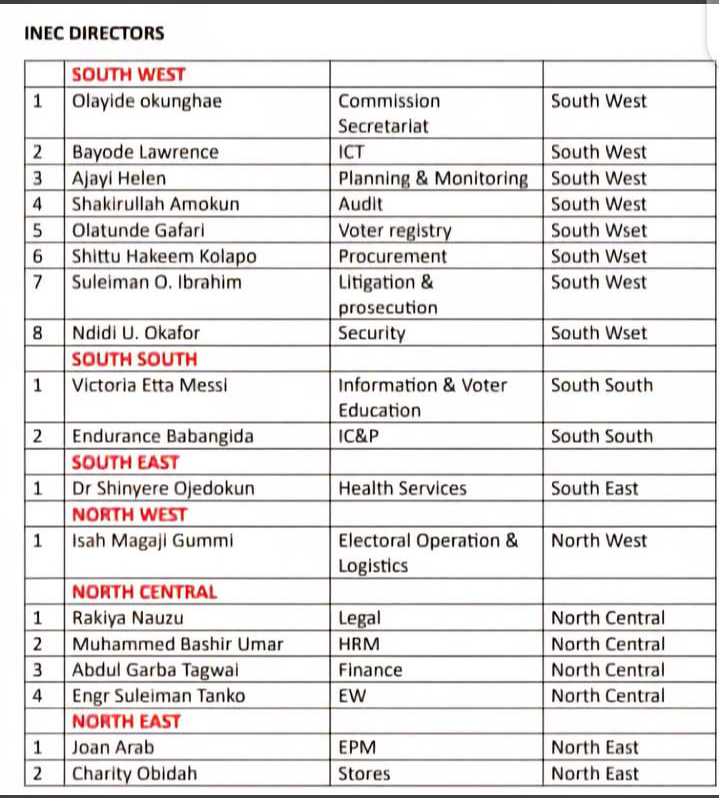
According to a breakdown circulating in public discourse, the South-West occupies seven of the 15 directorate positions listed at INEC headquarters, including Directors of Information and Communication Technology, Procurement, Planning and Monitoring, Litigation and Prosecution, Commission Secretariat, Voter Register, and Audit.
The North-West is listed as having one position, Director of Electoral Operations and Logistics, while the North-Central occupies three positions covering Human Resources, Finance and Legal Services. The North-East is credited with two positions, Stores and Electoral Operations and Planning Management, while the South-South has one position, Director of Gender.
The South-East, meanwhile, is listed as having two positions: Directors of Voter Education and Administration.
If verified, the distribution raises legitimate questions about the regional spread of senior administrative appointments in an institution entrusted with managing Nigeria’s elections. However, the figures require independent verification against INEC’s official staff records, and regional origin alone does not establish that an appointment was made on a nepotistic basis.
Beyond the numbers, the controversy touches on a fundamental question: should an institution responsible for safeguarding the democratic rights of more than 200 million Nigerians be perceived as reflecting the interests of one region more than others?
INEC occupies a uniquely sensitive position in Nigeria’s democracy. Its credibility depends not only on the conduct of elections but also on public confidence in its institutional independence, impartiality and adherence to the law. Any credible allegation of regional imbalance within its leadership deserves a transparent response rather than political dismissal.
The situation also presents an uncomfortable question for President Tinubu’s allies from the South-East and South-South. Umahi, Soludo, Uzodimma and Wike are influential political figures whose voices carry weight in national political discussions. Their supporters may reasonably expect them to address questions of fairness and inclusion, particularly when such concerns involve an institution as critical as INEC.
Must every debate about national fairness be reduced to a contest between Tinubu and former Labour Party presidential candidate Peter Obi? The issue goes beyond personalities and political parties. It concerns whether the Nigerian state treats its constituent regions with fairness and whether public institutions inspire confidence among citizens regardless of their ethnic or geographical origins.
Nigeria’s commitment to national unity cannot be measured solely by political slogans or the presence of representatives from different regions in government. It must also be demonstrated through transparent appointments, equitable opportunities and the consistent application of constitutional principles.
The administration of former President Muhammadu Buhari faced repeated criticism over allegations of regional imbalance in federal appointments. Critics now argue that the Tinubu administration risks reviving the same controversy if concerns about the distribution of senior positions across federal institutions are not addressed with credible evidence and clear explanations.
The All Progressives Congress (APC) came to power in 2015 on the promise of change. But the meaning of change must extend beyond replacing one administration with another. It must include stronger institutions, accountable leadership, fair representation and public confidence that government decisions are guided by competence and the national interest.
Indeed, if Nigerians had complete confidence in the impartiality of electoral institutions, the regional origins of individual directors would attract far less public attention. The real test is whether the system is sufficiently transparent and independent to convince citizens that electoral administration is not influenced by ethnic, sectional or partisan considerations.
A Nigerian president of Igbo extraction would face the same obligation as a president from any other region: to uphold the Constitution, respect federal character and ensure that national institutions serve all Nigerians. No president should be presumed incapable of wrongdoing because of ethnic identity, just as no president should be excused from scrutiny because of political affiliation.
The demand, therefore, is not for ethnic retaliation or the replacement of one regional dominance with another. It is for verifiable facts, transparent criteria for appointments and demonstrable compliance with the constitutional principle of federal character.
For Umahi, Soludo, Uzodimma and Wike, the question is straightforward: Do they consider the reported distribution of INEC’s directorate positions fair, and will they publicly support a transparent review if the figures are confirmed?
For President Tinubu and INEC, the responsibility is equally clear: address the concerns with verifiable information, explain the appointment process and demonstrate that competence, merit, institutional independence and national inclusion remain the guiding principles.
Nigeria belongs to all its citizens. Its electoral umpire must not only be impartial; its leadership structure must also command public confidence that every region has a fair opportunity to contribute to the democratic process.
The ultimate question is not whether an appointee is Yoruba, Igbo, Hausa, Ijaw or from any other ethnic group. It is whether the system is fair, transparent and worthy of the trust of every Nigerian.